Studentpage WUR
Information on hepatitis B for occupational risk groups for Wageningen University and Research

About Us
Vaccinatiecentrum.nl is a travel clinic, founded by Marchel Ratering. We are a modern and dynamic organization that is progressive in the field of travel and health advice. Thanks to our expertise and experience, travelers can come to us with all questions; before, during and after the trip. We are a registered yellow fever center, affiliated with the LCR (National Coordination Center for Traveler Advice) and ISO 9001:2015 certified. Our organization is characterized by expertise and personal attention. We achieve this by working with a small and close-knit team of nurses, telephone operators, (quality) manager and our ultimately responsible doctor.
Vaccinatiecentrum.nl has a partnership with the University of Wageningen and provides the Hepatitis B vaccination series for your education.
Hepatitis B
Make an appointment via one of the buttons below.
Location: Plantage 8, 6708 WJ Wageningen
Your university offers you the opportunity to be vaccinated against hepatitis B. This vaccination is offered because you will follow the course ‘Practical Tools for Molecular Nutrition Research (HNH47806)’ starting in period 3 or you are following specialisation B (Nutritional Physiology and Health Status). By following this course or specialisation you are at increased risk of getting infected with hepatitis B, taking the hepatitis B vaccination is strongly recommended.
The hepatitis B vaccination is offered free of charge. A hepatitis A vaccination is also recommended for specific professions. This vaccination is offered at the same time as the hepatitis B vaccination. If you opt for the combined vaccination, there are costs involved.
On this page you will find more information about the hepatitis A and B vaccination. If you still have questions after reading the information, please check the FAQ (Frequently Asked Questions) at the bottom of the page. If you have a question that does not appear in the FAQ, you can always e-mail us at info@vaccinatiecentrum.nl or call 085 902 03 03 (available Monday to Friday between 08:30 and 16:00) please mention you’re the course code HNH47806.
Please note!
Even if you have already had one or more hepatitis B vaccinations, we ask you to always attend the first vaccination day. This is because you may need a booster vaccination or an antibody check (blood sampling). Fill in the health declaration and bring proof of your previous hepatitis B vaccinations (vaccination certificate) with you to your appointment, on this basis we will assess whether there are things that still need to be done.
Hepatitis B
What is hepatitis B?
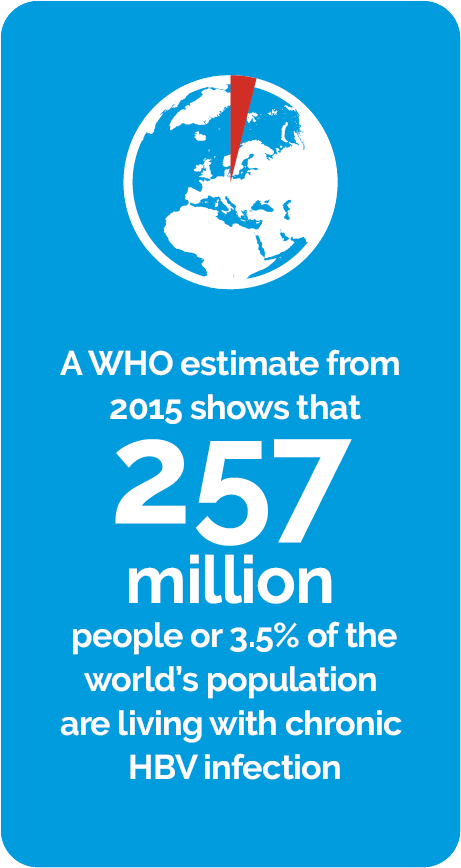
Hepatitis B is a viral infection of the liver that occurs all over the world. Usually, a person becomes ill 2 to 3 months after infection. Symptoms are often mild or completely absent. When a person does develop symptoms, they often include fatigue, fever and jaundice. In a small number of cases, hepatitis B causes serious complications that can be life-threatening. In a small number of people, the disease does not cure on its own. In these cases, the infection with hepatitis B becomes chronic. When the disease is chronic, it can affect the liver in the long term and cause liver cirrhosis and liver fibrosis.
How do you get hepatitis B and why am I at increased risk?
How do you get hepatitis B and why am I at increased risk?
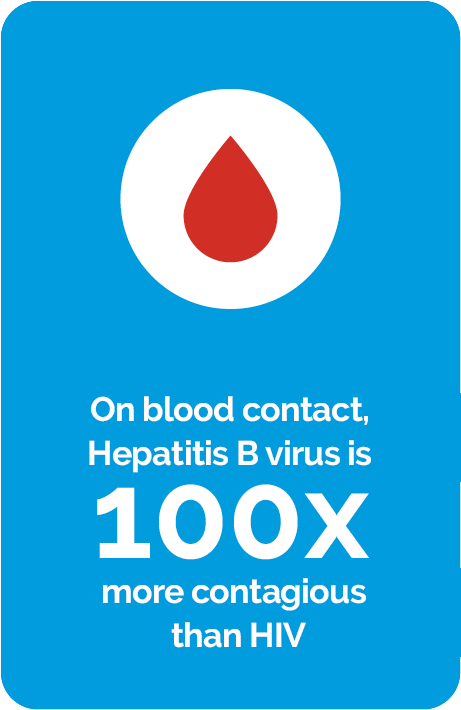
The hepatitis B virus can be found in semen, pre ejaculate, vaginal fluid and the blood of an infected person. This makes the virus transmissible through sexual contact or contact with blood from an infected person. The virus can also be transmitted from mother to child at birth.
In the case of work-related risks, infection mainly occurs through needle, cut, splash or biting incidents. You are not only at increased risk while working in hospitals. Also in laboratories where you work with human blood samples or where others work with human blood samples.
How does the vaccination process work?
The hepatitis B vaccination series consists of three vaccinations. After you have had all the vaccinations, we do a blood test to check whether you are well protected against the hepatitis B virus. For the test, a sample of blood is drawn from a vein in your arm. All vaccinations and the blood test take place at our location on the university campus. You get the second vaccination one month after the first vaccination and the third vaccination follows 6 months after the first vaccination. The blood test takes place 1 month after the third vaccination. You will receive the results of the blood test within a month after the blood test. You should keep this result in a safe place because your employer may ask for it as proof that you are vaccinated and protected against hepatitis B.
Hepatitis A
What is hepatitis A?
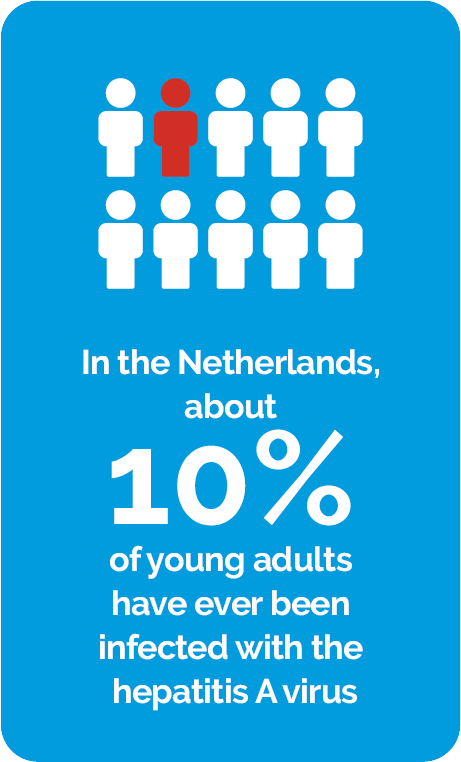
Hepatitis A is an inflammation of the liver caused by a virus. The time between infection and getting sick is about 28 days. Children usually do not get sick, adults often do. The symptoms of hepatitis A start with fever, lack of appetite, nausea and abdominal pain. After a few days, the skin and whites of the eyes turn yellow, the urine is tea-coloured and the stool is the colour of putty. These symptoms persist for about two weeks. Recovery can take months, which includes complaints such as fatigue and lethargy.
How do you get hepatitis A and why am I (potentially) at increased risk?
The hepatitis A virus can be found in the faeces of an infected person. If traces of faeces end up on food or in drinking water, a person can be infected. Hepatitis A can also be transmitted through door handles, water taps and towels. For specific professions, a hepatitis A vaccination is recommended in addition to the hepatitis B vaccination. Think, for example, of endoscopists. It may also be wise to be vaccinated against hepatitis A if you go abroad for an internship. A hepatitis A vaccination is also recommended for many popular holiday destinations, such as Morocco, Egypt and Turkey.
How does the vaccination process work?
We offer the hepatitis A vaccination as an additional option at a reduced price. This vaccination is not paid for by the school/university and you must pay for it yourself.
Some health insurance companies reimburse all or part of the cost of this vaccination. You can try to claim these costs from your own health insurance company. If you want to make use of this offer, make sure you have a debit card with you or make sure you can pay in cash during all three vaccination appointments. We will send you an invoice by e-mail that you can submit to your health insurance company.
If you would like the (optional) hepatitis A vaccination, you can tell us on the first (or second) vaccination day. In most cases we use a combination vaccine containing both the hepatitis B and A vaccine. Because both vaccines are in the same shot, you usually do not need an extra shot. In some cases, you may be given a separate hepatitis A vaccination in addition to the hepatitis B vaccination. This may be the case if you have had a hepatitis A vaccination before but the series was never completed. Have you been vaccinated against hepatitis A before but the series was never completed? In that case, bring proof of the vaccinations you have already had (vaccination passport or vaccination card).
Frequently Asked Questions
The vaccinations against Hepatitis B are not mandatory but they are highly recommended.
You have an increased risk of getting in contact with Hepatitis B in your education and future workplace. That’s why we also recommend you to do a bloodtest to see if your body has made enough antibodies against Hepatitis B.
All students are recommended to come to the vaccination day to get the vaccinations.
If you’re not able to attend the vaccination day, you can get the vaccination at one of our centres. Note that we will charge you €19,95 administration costs.
If you choose not to get vaccinated, please inform us by email: peggy@vaccinatiecentrum.nl.
If you’re only able to book a time when you’re in an online class, please give us a call on 085-9020303 so we can schedule your vaccination appointment together.
We recommend all students to come to the vaccination day, even if you already have had vaccinations. It’s possible we recommend an additional vaccination and/or the bloodtest.
Please fill out the Health Declaration and take the vaccination history/certificate with you to the vaccination day. Based on your vaccination history we can decide the next steps.
If you’ve already had the vaccinations and bloodtest for Hepatitis B, you can email us your name, date of birth, course code (HNH47806) vaccination history (of Hepatitis B) and the result of your bloodtest to: peggy@vaccinatiecentrum.nl so we can complete your file.
In some cases we may recommend you to take an additional vaccination and/or bloodtest.
If you do the bloodtest at vaccination day or at a location of Unilabs there are no extra costs. If you go to one of our centres we will charge €19,95 administration costs. If you decide to do the bloodtest somewhere else, for example your general practitioner, you have to pay the bloodtest yourself.
We recommend all students to come to vaccination day, even if you already have had vaccinations. It’s possible we recommend an additional vaccination and/or the bloodtest.
Please fill out the Health Declaration and take the vaccination history/certificate with you to the vaccination day. Based on your vaccination history, we can decide the next steps.
Hepatitis B is vaccinated in a series of 3 vaccinations, normally given in month 0-1-6. About 4 weeks after the vaccinations, the bloodtest takes place. Sometimes the schedule may look different.
The university pays for the hepatitis B vaccinations. If you don’t show up for the vaccination day but make a personal appoinment at one of our centres, we will charge you €19,95 administration costs. The costs must be paid at the appointment per PIN.
You have to pay for the hepatitis A vaccination yourself, the costs are € 90. If you opt for the hepatitis A vaccination or if you want to buy a vaccination passport, you pay for this per appointment. For the combined hepatitis A + B vaccine, this is 3x €30. For a separate hepatitis A vaccination, that is €45. A vaccination passport costs €7,95 You can only pay by pin. You will receive the invoice digitally.
The bloodtest is only free of charge if done by us at vaccination day or at a location of Unilabs. If you go to one of our centres we will only charge €19,95 administration costs.
If you do the bloodtest somewhere else, at your general practitioner for example, you have to pay the bloodtest yourself.
No, this is not required if you have the age of 16 or older.
We only work with experienced nurses who can reassure you. There is no need to bring someone with you. It is important that you indicate this. You can indicate this on the Health Declaration. To reduce pain during injections, we have several tools available;
- The Buzzy®: This is a little ladybug that vibrates and has cold pads in the shape of wings. Thanks to its vibrating and skin-cooling effect, the Buzzy provides distraction and a proven pain-relieving effect during injections. The Buzzy is placed on the injection site before the injection and remains between the injection site and the brain throughout the process (“between the pain and the brain”). The buzzing and vibrating of the Buzzy disrupts the nerves in that area, so the sharp pain is not felt. A sensation of touch may still be present, but the pain of the injection is no longer experienced.
- The Shotblocker: This is a little plastic disc with small nubs that is placed around the injection site and pressed firmly against the skin. The small bumps on the Shotblocker activate the nerve fibers in the injection zone. This temporarily masks the pain signals, allowing the signals from the injection to be muted and perceived as less painful.
We have had many positive experiences with both pain relief tools and use them for all types of injections, for both children and adults.
The likelihood that you are not protected against a hepatitis B infection after this vaccination course is very small. In the rare case that you are not protected, the necessary laboratory procedures must be carried out by group members who are protected. However, you can still be assigned to a group as a test subject, where blood may be drawn from you as part of their research.
You are not required to get vaccinated for this course, but it is strongly recommended. If you choose not to get vaccinated, you have the right to do so. In that case, you will be assigned to, or must choose a group that does not work with human blood. However, you can still be assigned to a group as a test subject, where blood may be drawn from you as part of their research.
It is possible that for medical reasons you may (temporarily) not be allowed to have blood drawn or receive a vaccination. Are you unsure about this? Please contact us by phone at 085 902 03 03.
The CDC has a good, comprehensive website on this topic. You can find it here:
https://www.cdc.gov/hepatitis-b/about/index.html
At Wageningen University, this is partly addressed through a protocol for “needlestick incidents” (this will also be available on the course’s Brightspace page in due time), which ensures that appropriate medical advice can be provided quickly and that serious consequences are minimized.
In addition, risk assessments related to working with human blood have shown that Hepatitis B is the only ‘mandatory’ vaccination.
You don’t have to do anything. The university is not allowed to keep records of those who were vaccinated. Therefore it might be that you have received an invitation to start vaccinating but the message does not apply to you.
If you are unsure please contact us by emailing peggy@vaccinatiecentrum.nl