
Tick borne encephalitis
Dit blog is gepubliceerd op 19 november 2019 en geactualiseerd op 22 juni 2023
Most outdoor enthusiasts are all too aware of the danger posed by ticks.
The widespread attention to Lyme disease means that more and more people know about the symptoms, treatment and prevention of a tick bite. What far fewer people know is that ticks can also transmit another disease: namely tick-borne encephalitis, or TBE, a disease caused by the TBE virus. Do you enjoy camping, hiking, gardening or other outdoor activities? In this blog, you’ll learn how to recognize, treat and, of course, prevent TBE.
What is tick-borne encephalitis?
Tick-borne encephalitis is meningitis or encephalitis caused by the TBE virus. This virus is transmitted by infected ticks. Before 2016, this virus was almost exclusively found abroad, but since then the virus has also been found in ticks in the Netherlands. It is therefore important when informing people about ticks to talk not only about Lyme disease but also about tick-borne encephalitis.
What happens when you have a TBE infection?
There are different subtypes of the virus, but the symptoms are generally similar. Usually, infection with the TBE virus does not cause any problems. In many cases, a person does not get sick. However, when someone does get sick and the infection progresses to tick-borne encephalitis, you can distinguish two phases.
The first phase begins 7-14 days after the tick bite. During this phase, a person may experience headaches, muscle aches, fever and nausea. However, one-third of infected people do not notice this phase. This phase lasts 2-7 days and is often followed by a week without symptoms.
During the second phase, two types of inflammation may develop: inflammation of the brain tissue (encephalitis) and/or of the meninges (meningitis). During this stage, symptoms such as severe headache or fever occur and hospitalization is necessary. There are currently no medications to treat tick-borne encephalitis.
How do I prevent infection with the TBE virus?
In the case of tick-borne encephalitis, it is easier to take preventive measures against a tick bite than to treat the disease when an infection occurs. By taking preventive measures before you put yourself in a high-risk situation, you significantly reduce the chances of a tick bite. You are at increased risk of a tick bite when:
- It is spring or summer
- You go to forests or grassy areas
- You undertake an outdoor activity such as camping, biking or hiking
- You are outside for long periods of time for other reasons
Areas in Europe where ticks may carry the TBE virus include Germany, Estonia, Hungary, Latvia, Lithuania, Croatia, Austria, Poland, Slovenia, Slovakia and part of Scandinavia. In these areas, as well as in the Netherlands and other countries where ticks are present, it is wise to take preventive measures. Wear long sleeves, long pants and tuck your pant legs into your socks. Use insect repellent with DEET and check yourself and others for ticks afterwards.
Remove ticks with tick forceps, clean the skin with alcohol and keep a close eye on the affected skin for the next few days. The TBE virus is transmitted almost immediately after the bite, but quick removal seems to reduce the chance of infection. In addition, removing the tick reduces the chance of contracting another disease, such as Lyme disease.
Vaccination against tick-borne encephalitis
Vaccinatiecentrum.nl offers a vaccine that provides up to 95% protection against TBE. This vaccine protects against each of the three subtypes of TBE. A tick-borne encephalitis vaccination is especially recommended if you plan to spend an extended period of time in an area where TBE is prevalent.
The vaccine against TBE consists of a series of three vaccinations. Before departure, two vaccinations are given one month apart. After 6-12 months, or before the start of the next tick season, a booster vaccination is given. After this, you are protected against tick-borne encephalitis for three years.
If you are going to a country where tick-borne encephalitis is prevalent or if you plan to spend a lot of time in nature, feel free to book an appointment at vaccinatiecentrum.nl for a personalized health consultation.
Thailand and Bali local foods
Dit blog is gepubliceerd op 7 mei 2023
Our nurse Lisanne tells:
“I have always intended to go on a long and distant journey one day. For this reason, my sister and I decided that we would travel around Thailand together and then fly to Bali. We only booked the outward and return flights, the rest we would figure out along the way. For the travel vaccinations, we first went to vaccinatiecentrum.nl for advice. I would need the DTP (diphtheria, tetanus, polio), hepatitis A and rabies vaccinations. I had already had most of these vaccinations, requiring only a repeat DTP vaccination. Because we were in Asia for less than 3 months, a typhoid fever vaccination was not necessarily needed either. Apart from vaccinations, one of the most important pieces of advice was to wash your hands well and make sure the food was prepared properly. If you do not prepare your food yourself, you should make sure it has been prepared in a way that ensures that bacteria and viruses in the food die before you eat it.
We landed in Bangkok, the capital of Thailand, and right away we had to get used to the different culture and people. There were scooters everywhere and lots of taxi drivers approached us. We were among the first tourists to come back to Thailand after tourism had virtually stopped because of the Covid pandemic.
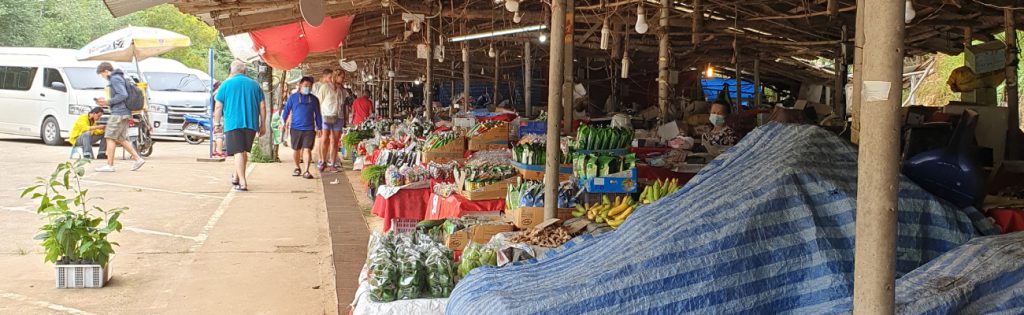
We soon saw that locals did not eat in restaurants, but mainly got food from street food stalls. This made us very curious about the food prepared in these stalls. Because both my sister and I did not speak Thai, we did not know what we would get, but we decided to queue at the back of a busy street food stall anyway. When it was our turn, fresh Pad Thai was being prepared before our eyes. This is a local dish usually made with a lot of spices, noodles and prawns. When we ate this we found out why there were so many people queuing for it, it was really delicious and it only cost 80 cents!
After that delicious pad thai, we got a taste for street food and tried several stalls. One of these stalls sold pre-cooked meat unknown to us. Unfortunately, my sister and I woke up the next day with a slight stomach ache and diarrhoea, probably something was wrong with the meat after all. We had not paid close attention to ensure ourselves that the meat was well-cooked and freshly prepared. Fortunately, both of us were only sick for a day and then we were able to get back to our adventure.
When we left for Bali, we thought we could expect pretty much the same in terms of food and street food stalls. Yet this was different in Bali than in Thailand. There were fewer street food stalls here and Bali was more focused on tourism. Often there was an English translation next to the indonesian text or the vendor spoke English. Also, people in Bali use a lot more chilli and spice in their food. In Bali, we had dinner with locals my friends had met while fishing for tuna. The fisherman’s wife had prepared tuna, prawn crackers and a salad for us. With the few words of English she knew, she explained to us that she had made the food less spicy for us because she was afraid it would otherwise be too spicy. Full of enthusiasm, we started eating and very soon all our faces turned red. Even though the woman had made it less spicy, it was still very hot. Nevertheless, it was delicious even though I normally don’t even like fish. The fact that it was very spicy didn’t stop us from eating it all. Though we couldn’t taste much for the next two days.”
Your health and the Hajj
Dit blog is gepubliceerd op 8 november 2019
Your health and the hajj or umrah: this is how to stay healthy during your trip
Good physical health is one of the prerequisites for participating in the hajj. To ensure that you stay healthy during and after the hajj, it is wise to take some precautions. Some precautions, such as getting certain vaccinations, are also a prerequisite for making the hajj. In this blog, we will tell you more about which vaccinations you need, why they are important and when to get them.
What are the health risks during the hajj?
The hajj is not without danger. First of all, temperatures can reach 50⁰C, posing an elevated risk of sunstroke, dehydration or sunburn. In addition, the large crowds bring several risks. During the hajj, many people gather together, allowing diseases to spread easily and quickly.
You can reduce your chances of getting sick in several ways, such as paying close attention to hygiene and protecting yourself from the sun and heat. Preventive measures include:
- Drink plenty of water and take ORS (oral rehydration solution) with you. This is a solution of water with sugar and salts that you use to replenish fluid loss due to the heat. This reduces the risk of dehydration.
- Protection from the sun. To avoid sunstroke, bring a (white) parasol. Also remember to use sunscreen with a high SPF (Sun Protection Factor).
- Keeping hands clean. Wash them more often than usual and take a disinfectant cream or hand gel to kill bacteria. Try to avoid contact with animals. If contact with animals cannot be avoided, for example during a slaughtering ritual? Then disinfect your hands thoroughly afterwards.
- A mouth mask to reduce the risk of respiratory infections.
If you are going to have your head shaved bring your own razor blades and replace them after each use. When shaving, never use a blade that has already been used by someone else. Sharing razor blades increases the risk of infection with blood-borne diseases such as hepatitis B, hepatitis C and HIV. You can get vaccinated against hepatitis B. There are also vaccinations for other diseases you can contract during the hajj.
What vaccinations do I need for the hajj?
Some vaccinations are a prerequisite for participating in the hajj, while others are recommended. Which vaccinations you do or do not take should be carefully considered.
Obligatory vaccinations for participation in hajj
Vaccination against meningitis (inflammation of the brain) is obligatory for everyone over the age of two. This requirement is imposed by the government of Saudi Arabia. It covers meningitis types A, C, W135 and Y. The meningitis ACYW135 vaccination protects you against meningococcal disease. This disease can lead to meningitis or blood poisoning, which can quickly lead to shock with fatal consequences.
For children under 1 year of age, the ACYW135 vaccination schedule consists of several vaccinations. For adults and children older than 1 year, one vaccination is sufficient. This vaccination is valid for five years and must be administered at least 10 days before the start of hajj. How long the vaccination actually protects against meningitis is still uncertain. It is assumed that protection lasts about 3-5 years.
Recommended vaccinations for the hajj or umrah
Besides the obligatory vaccinations, there are some other vaccinations we recommend getting before your trip. To reduce the risk of contracting diseases during the hajj, we recommend you also get vaccinated against hepatitis A and B, diphtheria, tetanus and polio (DTP). The DTP vaccination is included in the national vaccination programme and provides protection for 10 years. A booster vaccination is usually not necessary for children, but for adults we recommend a booster vaccination in most cases. If you have any questions about this, feel free to book an appointment. We will be happy to give you advice based on your personal circumstances.
As mentioned earlier, it is recommended to bring your own razors if you want to shave your head. If this is not done safely, you run the risk of contracting hepatitis B, hepatitis C and HIV. You can get vaccinated against hepatitis B, but not against hepatitis C and HIV.
For all obligatory and recommended vaccinations for the hajj or umrah, you can book an appointment with us. Feel free to drop by for a personal consultation or ask about the possibilities of being vaccinated at your location. Hajj Mabrour!

Why personal travel health advice still matters


Why personal travel health advice still matters
My children buy clothes online. They try them on and return them. We no longer cook for ourselves but order food and have it delivered to our door. In healthcare, we are also increasingly shopping around, and we are all scouring the internet for cheap healthcare and special offers.
Health insurance providers are following this trend. I think that in 10 years’ time, we won’t have our own GP or dentist anymore. If you need to see a dentist or GP, you’ll log in to a website and visit a GP or dentist assigned by your health insurance provider.
In this day. where there is less and less human contact and personal attention, yet the need for it is actually growing, I think it is time to realise that we are heading in the wrong direction. I believe that small scale and the people youbtrustm are the ones who can give people the quality they need.
I always buy my household appliances from a small retailer in the town where I live. I trust the people who work there. I’ve known them for years and am convinced of their expertise.
If something breaks, I can go back and have it repaired. If I have any questions, they can answer them. The service is excellent and I always go home feeling happy.
If you’re planning a trip to the tropics, taking your children to a faraway destination, or need information about the side effects of malaria tablets, it’s comforting to know you can count on an organisation you trust and where you know the people. That way, your journey begins with personalised, expert advice.
I hope the trend in the healthcare sector will reverse. Many of the vaccinatiecentrum.nl loyal customers have been coming here for years and have trust in our knowledge and expertise. Due to the policies of insurance companies, many of these loyal customers are being forced to get their vaccinations elsewhere. Fortunately, many people are switching insurance providers so that they can continue to come to us for vaccinations and advice.
As an organisation, we are doing everything we can to ensure the quality of our vaccination services and travel advice remains high. Time will tell which direction we are heading in these uncertain times, as we find ourselves growing increasingly distant from one another.
Foto: Joseph Chan on Unsplash
The impact of rabies
Dit blog is gepubliceerd op 6 november 2019 en geschreven door Marchel Ratering
Rabies is an infectious disease that is relatively rare in the Netherlands. According to statistics, 3 people have died in the Netherlands from Rabies in the past 25 years.
The impact of a dog bite, or contact with a mammal in the sub(tropics) is usually significant. In recent years, advice to travellers on rabies has been given more frequently by vaccination centres. It is discussed whether or not to vaccinate after which people often choose not to vaccinate (partly influenced by protocols). People often choose not to vaccinate because of the extra cost and because they assume the chance of a mammal bite is small.
This is absolutely right as far as I am concerned. It is important that people who come to a vaccination centre are advised about this and that people know that it is better to stay away from animals. This means not petting dogs, cuddling cats or having their picture taken with a monkey and, of course, leaving bats alone.
Despite this, I have noticed that in recent years, people are having more and more contact with mammals in the tropics and that people are increasingly worried about infection. The number of people receiving treatment after a bite has increased. This means that people are more and more aware of the risk of Rabies and are worried about (even minimal) contact and would like treatment when this happens.
Rabies vaccination before a trip to the tropics is a very good investment
Let’s circle back for a moment to the 3 people in the Netherlands who died of Rabies in the past 25 years. All three had not been vaccinated against Rabies prior to their trip.
In my professional opinion, getting vaccinated before a trip to the tropics is a very good investment. You only need to do it once after which you are protected for the rest of your life. Protected in this case means that your body builds up immunological memory against this virus. This immunological memory lasts throughout your life and means that after a bite or contact with a mammal that might be infected with rabies, you don’t have to do anything but wash the wound with soap and water, disinfect it for a while and preferably get two Rabies vaccinations as soon as possible. How soon you should get these vaccinations depends on where on your body you have been scratched, bitten or licked and the severity of the wound. With scratching, there is a chance of infection but this chance is small. In case of biting, the chance is higher, so in that case, go and get a rabies vaccination as soon as possible. The vaccination stimulates your immune system’s memory cells to produce antibodies. As a result, your body makes its own protective immune cells.
If you are vaccinated before travelling, you don’t have to worry about getting immunoglobulins after coming into contact with a mammal (Marig: “human anti rabies immunoglobulin”). These immunoglobulins are difficult to obtain in many countries and the quality can also vary greatly in the tropics.
If you are going to the tropics, I recommend you read the information on Rabies carefully.
Travel safely and without worry
I myself was vaccinated against Rabies 10 years after my first trip.
It was only when I started travelling with my children that I noticed how vulnerable we are as human beings and that it is wise to protect yourself as much as possible. Even though the chances of getting sick while travelling are slim, you still have a lot less to worry about if you travel well prepared and with the right vaccinations.
As I was writing this blog, I received a call from a traveller who had been bitten by a dog in Thailand. He had not been vaccinated against rabies and told me that he had gone to the hospital in Thailand because he did not know what to do. There he received vaccinations against Rabies. After 2 weeks, he learned that he actually should have had Marig. Now he is worried because that means he actually didn’t get the right treatment.
Every day, travellers in the (sub)tropics are bitten or scratched by mammals. The impact of a bite during your trip is very significant. By getting vaccinated against rabies before your trip, you can travel safely and without worry.
Marchel Ratering, registered traveller nurse and owner of vaccinatiecentrum.nl